
Tags
#AcceptanceCriterion, #Agile, #AgileSoftwareDevelopment, #AgileTraining, #Backlog, #Communication, #Dailyscrum, #DailyStandup, #Gandhi, #LatestInAgile, #Nirbhay, #NirbhayGandhi, #ProductOwner, #Scrum, #ScrumMaster, #Scrummeetings, #Scrumming, #Scrumrituals, #ScrumTeam, #SoftwareDevelopment, #UserStory
Hello everyone! Welcome to Day 4, 2015. How is it going so far? If you ask me, I am still recovering from the NYE party, was out all night after such a long time. It was such a great fun though. 🙂
Guess now its time to get back to business again. So far we have talked about how we can plan better for our sprints, however, planning is just half the battle. How we execute the plan is the other half and that is where Daily Stand-Ups come in picture.
And because a PICTURE is worth a thousand words, today I want to try a different approach for explaining what daily stand-up session is all about and how critical it can be for a sprint’s success. I’ll try to use more pictures and less words to convey my message across and you let me know if it works better or worse. Deal?
What is Daily Stand-up?
 “Daily Stand-Up” aka, “Daily Scrum”, is a quick session where the team members regroup every day to communicate and update each other by answering three basic questions (covered below).
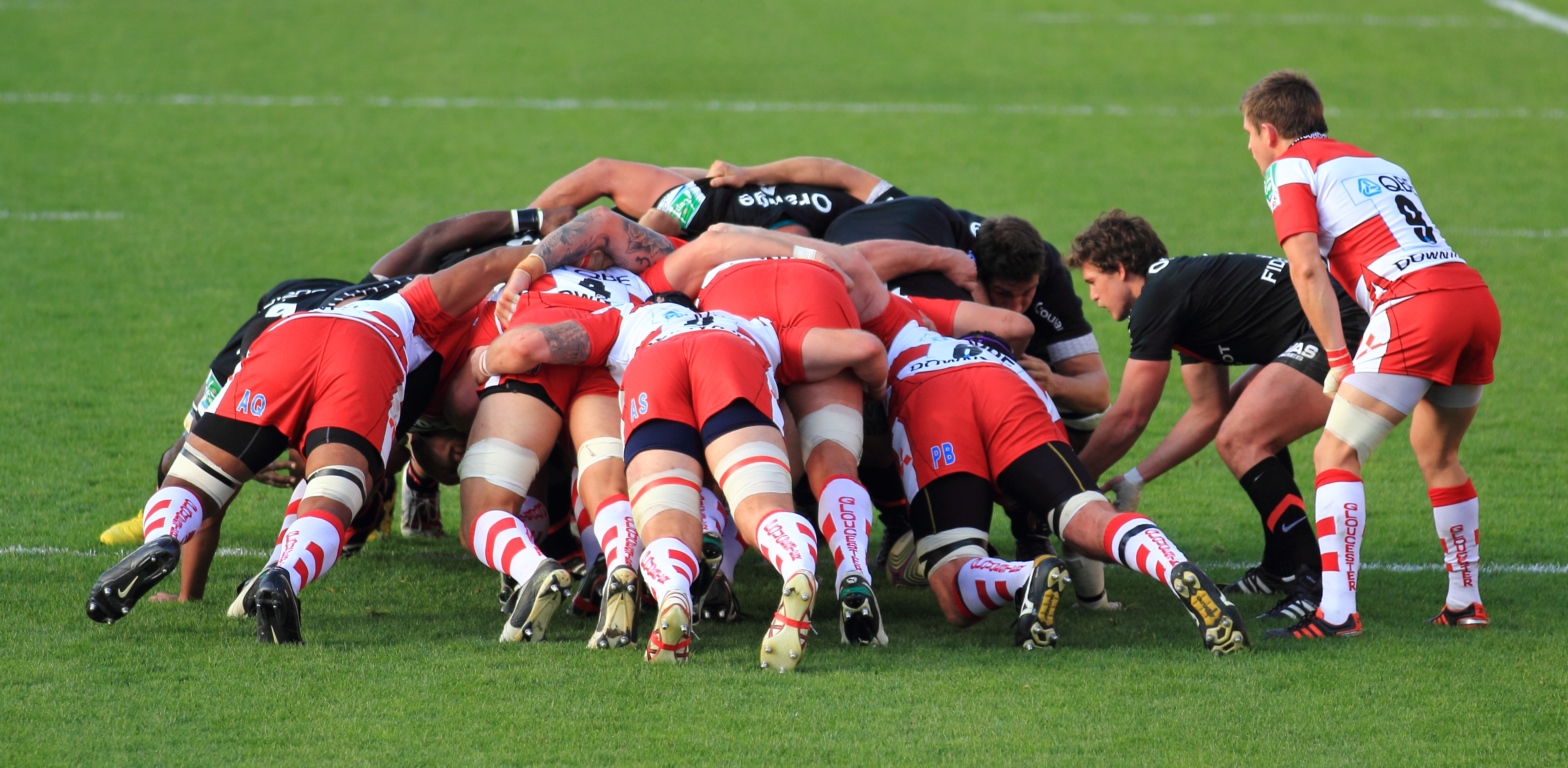
Daily Stand-Up
Why called “daily stand-up” – as the discomfort of standing for longer periods helps to keep the meetings short.
Why called “daily scrum” – as it somewhat paradoxically alludes to the huddle-like appearance of a rugby scrum. (refer Snorkeling in the Sea of Scrum for historical details).
What do we do in Stand-Up?
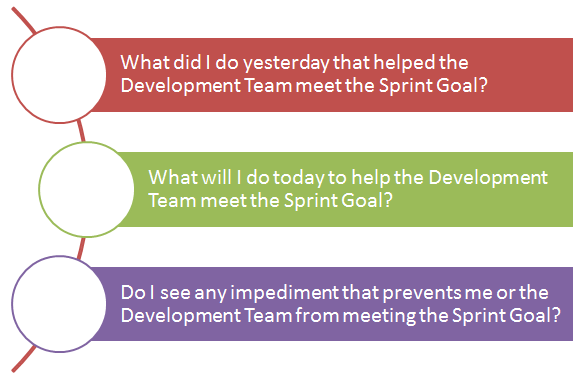 Each team member is expected to talk about three basic things. By talk, I do not mean go on and on about your accomplishments or issues, its a quick talk to let your peers know what you have done so far and what you intend to take up next and if you are impeded in any way.
How long is a Stand-Up?
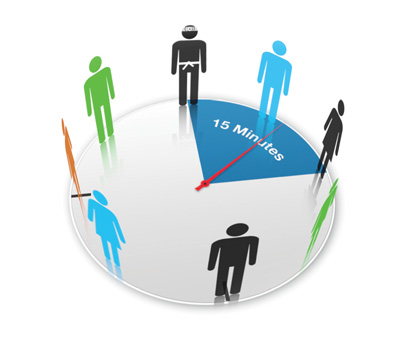
15 minute Stand-Up
Stand-ups are strictly time boxed to 15 minutes everyday. This time box can be adjusted for teams that are smaller or larger than the average teams. Team members may ask brief clarifying questions and get brief answers, however, there is no deep dive into the details at this moment. Any topic that needs a detailed discussion is added to the “parking lot” list and can be discussed with a subset of team, once the stand-up session is over. The intent is to not waste anyone’s time if they are not affected by the topic/issue being discussed.
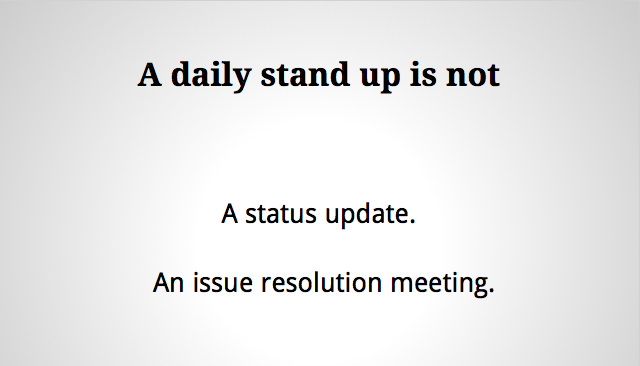
What Stand-Up is NOT:
- NOT a Status Meeting – This is THE most common pitfall for a stand-up meeting
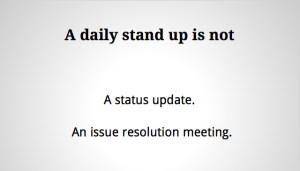 that it turns into a status reporting meeting. It is supposed to be a peer-to-peer communication meeting that ensures all team members are on the same page and are making progress towards the sprint goals as a team. Anyone outside the team who is interested in the team’s progress can come and listen as a “chicken”, however, the participation (talking) is strictly for team members, scrum master and product owner.
 - NOT an indefinite discussion forum – This is another common pitfall, where the discussion drags on and on, even beyond the 15 minute window. Neither is this a forum for detailed technical discussion, nor a session to discuss the upcoming product road-map.
- NOT for the Scrum Master alone – This is another very usual pitfall where each team member, while updating their status, maintains an eye contact with the scrum master alone and the rest of the team is either talking to other team members and/or busy playing with their cell phones or at the best, watching the team member who is talking to the scrum master. This is an indicative of a non-collaborative environment and that the team thinks of the scrum master as a project manager. Scrum Master is just a facilitator for this session and again, it should be a peer-to-peer communication.
- NOT a two question meeting – Very often the team members just talk about what they did the day before and what they are planning to work on today and a lot of times forget about the impediments. Its hard to believe that there are no problems or issues that team members face each day… no impediments, no risks, no obstacles? However, they do not bring them up in the stand-up. This can sometime be in an indicative of an unhealthy corporate culture that makes people uncomfortable discussing their difficulties in a group setting.
- NOT for micromanagement – In some cases, I have observed the scrum masters going over the status from previous day and/or going over each user story in the sprint backlog, doing a health-check confirmation with the respective team member. This is NOT a stage for the scrum master to be doing all the talking, it is for the team members instead. Scrum Master is just there to facilitate the session and should let the team members do the talking.
- NOT a ‘privately held’ meeting – In some instances, I have observed that the team members insist for a conference room for the stand-up session, so that they can discuss issues more openly. This is again an indicative of an fearful culture, where team members are hesitant to discuss their issues in open.
Perks of an effective Stand-Up:
 The daily check-in provides immediate recognition and resolution of problems, and promotes team’s self-organization and self-reliance. Peer-to-peer communication in a short focused and energetic meeting contributes to team cohesion. A stand-up well done helps maintain transparency, builds trust and boosts performance.
One last picture to summarize Stand-Up:
Now, will you stand up for the Stand-Up?
Happy Reading! 🙂
– Nirbhay Gandhi
 Nirbhay Gandhi