
Tags
#Agile, #AgileSoftwareDevelopment, #AgileTraining, #Kanban, #LatestInAgile, #Lean, #Nirbhay, #NirbhayGandhi, #Scrum, #SoftwareDevelopment
Hello people, how are you all doing? Welcome to my AGILE AND SCRUM DIVING SCHOOL. 🙂
During your time here, we will be doing multiple dives into the Agile Ocean and the Sea of Scrum. To start with, today we will do a small dive into the shallow waters of Sea of Scrum, or shall I say ‘Snorkeling in the Sea of Scrum’ 😉

Snorkel dive into Scrum
About 7 years ago, I was attending a session on Scrum. The speaker, started with a question, “How many of you know how to play Rugby?” I did not, but a lot of people in the room did and they raised their hands. For a moment I thought, “Am I this dumb not to know how to play Rugby?” Anyway, the session progressed and the speaker referenced to the game of Rugby more than a few times, after which I mustered up some courage to ask, “I have no clue about what Scrum stands for in Rugby, can you please explain a little more in detail?” to which he curtly replied, “It is a term used in Rugby” and moved on. Duh! if not anything, I had gathered that much by then. I was interested in the details, but to my dismay, I did not get any satisfactory answer from him. I was a little upset for a few moments, however, I could understand that this gentleman had a room full of 50 people to address and this stupid question was not his priority.
Although I learnt what Scrum meant in the world of Software development (atleast that is what I believed, I learnt), the relationship between Scrum and Rugby kept bothering me throughout the day. When I got home in the evening, the first thing I did was googled “Scrum in Rugby”, read about it and watched a couple of videos as well. So….
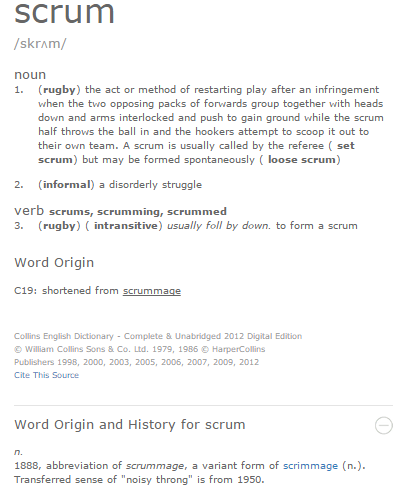
Dictionary meaning of Scrum (Rugby)
What is SCRUM in Rugby?
It is the act or method of restarting play after an infringement when the two opposing packs of forwards group together with heads down and arms interlocked and push to gain ground while the scrum half throws the ball in and the hookers attempt to scoop it out to their own team. A scrum is usually called by the referee (set scrum) but may be formed spontaneously (loose scrum).

Scrum way of making Strawberry Banana Pancakes
What is SCRUM in Software Development?
If I have to define Scrum in the most concise way possible, I will just use two words ‘Iterative’ and ‘Incremental’.
ITERATIVE – developing part by part, a small piece at a time, and
INCREMENTAL – developing each piece on top of the previously developed piece.
Think of it as, you want to have Strawberry Banana Pancakes but you can’t prepare the entire thing in one shot, can you? There is a stage by stage process to it, you make four banana filled pancakes, stack them on top of each other, then you crown them with cool strawberries and banana slices, and top it with whipped cream and strawberry sauce and Voila! Strawberry Banana Pancakes are ready. And I believe, scrum philosophy of software development is not that far from making strawberry banana pancakes. 😉
Its all about building a piece by piece, a bit by bit, a slice by slice, a story by story, one feature at a time, and in no time your product is ready. Its an effort to take all the unneeded strenuous tasks out of software development and make it more lively and fun process instead.
B.C. and A.D. of Scrum
A paper describing the scrum methodology, jointly presented by Ken Schwaber and Jeff Sutherland at the Business Object Design and Implementation Workshop held as a part of Object-Oriented Programming, Systems, Languages & Applications ’95 (OOPSLA ’95) in Austin, TX, led to a formal induction of Scrum into the list of lightweight software development approaches, and this marked the birth of Scrum in 1995. However, this is not when Scrum was first mentioned, considered, discussed or talked about as a lightweight approach for software development.
On January 1, 1986, an article “New New Product Development Game” co-authored by Hirotaka Takeuchi and Ikujiro Nonaka was published in Harvard Business Review. It is in this article Scrum was first defined as, “a flexible, holistic product development strategy where a development team works as a unit to reach a common goal” as opposed to a “traditional sequential approach”. Based on the case studies from manufacturing firms in the automotive, photocopier and printer industries, they concluded that this new approach to commercial product development would increase speed and flexibility. They called this the holistic or rugby approach, as the whole process is performed by one cross-functional team across multiple overlapping phases, where the team “tries to go the distance as a unit, passing the ball back and forth”.
A deeper dive into the details of Scrum in our next article – “Scuba dive in the Sea of Scrum“
– Nirbhay Gandhi
 Nirbhay Gandhi
Pingback: Stand up if you want to sit | Nirbhay Gandhi
Amazing article!! The best part about it is your pancake analogy, that made the article much more understandable. Thank you!
LikeLiked by 1 person
@shuchtandon, I am glad to hear that a simple analogy helped you understand more about agile and scrum. Believe you me, agile is just as simple as the analogy itself. 🙂
LikeLike